
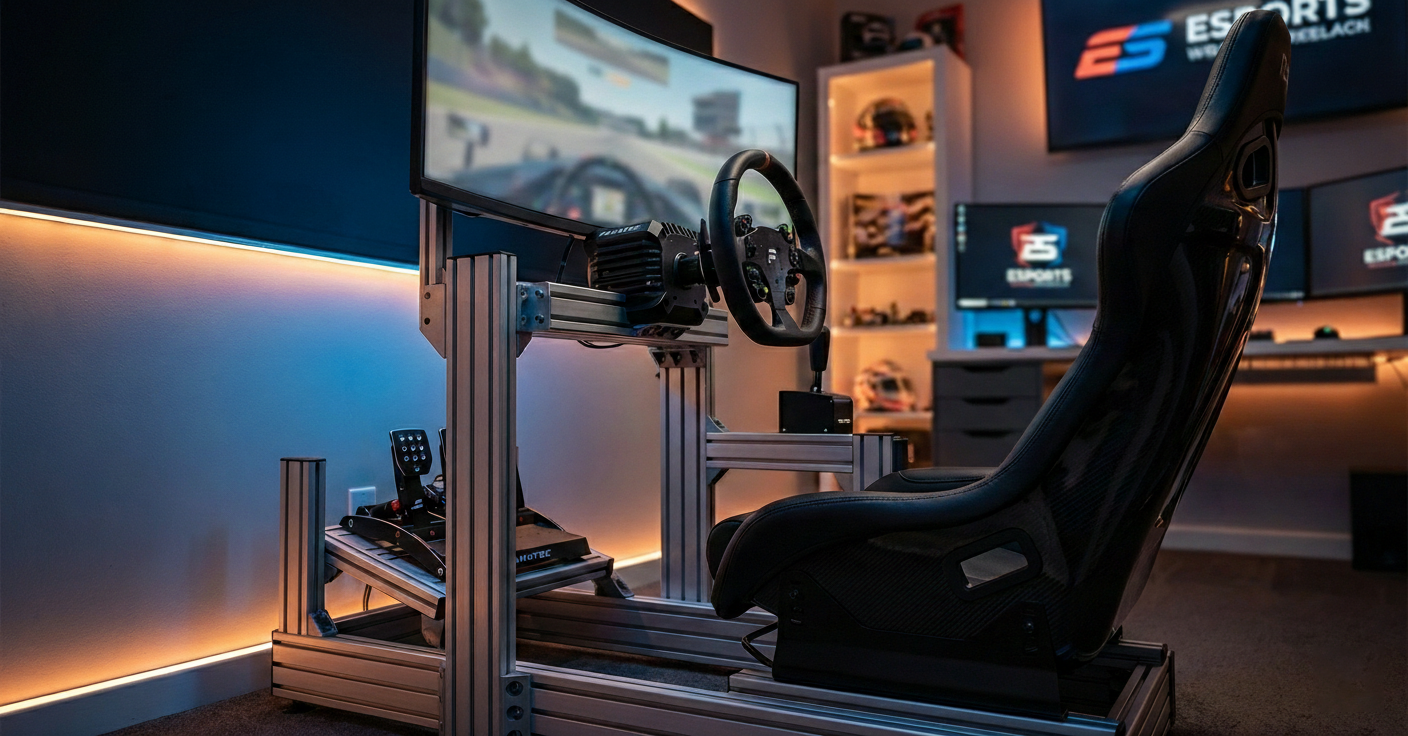
What defines a sim racing rig in 2026
A sim racing rig is not a single product. It is a system made up of three core pillars, each of which directly affects driving consistency and immersion.
-
The wheel base and steering wheel determine force feedback fidelity, torque headroom, and steering precision
-
The pedal set defines braking realism, muscle memory development, and lap time consistency
-
The cockpit or rig provides rigidity, ergonomics, and long-term comfort under load
In 2026, imbalance between these components is the most common mistake buyers make — for example, pairing a powerful direct drive wheel with entry-level pedals or mounting premium hardware to a flexible frame.
Entry-level sim racing rigs: what to expect and who they’re for
Entry-level rigs are built for accessibility, ease of setup, and broad compatibility. They are ideal for newcomers, casual racers, and users transitioning from controller racing.
Typical characteristics of entry-level setups include moderate force feedback strength, non-load-cell pedals, compact or foldable cockpits, and strong console support.
-
Wheel bases in this category usually use gear-driven or belt-driven systems delivering around 2–3 Nm of torque
-
Entry-level direct drive bundles have appeared, but they prioritize smoothness over raw power
-
Pedals are typically potentiometer-based, relying on pedal travel rather than braking pressure
-
Cockpits are lightweight, often foldable, and designed for limited space rather than maximum rigidity
In practical terms, an entry-level rig allows drivers to learn racing lines, braking points, and basic car control without overwhelming complexity. However, consistency under heavy braking and fine steering corrections remain limited compared to higher tiers.
Entry-level buyers should prioritize reliability and resale value rather than chasing specifications. Many racers upgrade within 12–24 months, making well-known ecosystems easier to sell second-hand.
Mid-range sim racing rigs: the sweet spot for serious enthusiasts
The mid-range category represents the most significant performance jump per euro spent. For many sim racers, this is the point where the equipment stops being the limiting factor and driver skill becomes the primary variable.
In 2026, mid-range rigs are defined by direct drive wheel bases, load-cell braking, and rigid cockpits capable of handling sustained forces.
-
Direct drive wheel bases in this tier typically deliver 5–8 Nm of torque, offering detailed force feedback without excessive fatigue
-
Load-cell pedals become standard, allowing braking to be based on pressure rather than movement
-
Pedal adjustability improves significantly, enabling fine-tuning of brake stiffness and throttle resistance
-
Cockpits move toward steel or aluminum profile construction, eliminating flex under braking
The most important upgrade at this level is not steering torque — it is braking consistency. Load-cell brakes allow drivers to develop repeatable muscle memory, which directly translates to improved lap times and racecraft.
Mid-range setups are also where modular ecosystems matter. Buyers should consider future upgrades such as stronger wheel bases, higher-end pedal sets, triple monitor mounts, or motion systems. Compatibility and mounting standards become increasingly important.
Professional sim racing rigs: tools, not toys
Professional rigs are designed for drivers who compete regularly, train seriously, or demand the highest level of realism and reliability. These setups are engineered for precision, endurance, and zero compromise.
Unlike entry and mid-range categories, professional rigs focus less on value and more on performance ceiling and consistency under load.
-
High-torque direct drive bases deliver sustained force feedback with high dynamic range and minimal clipping
-
Steering systems emphasize response speed, micro-detail, and thermal stability rather than headline torque figures
-
Pedal systems often combine load-cell technology with hydraulic or elastomer damping for progressive braking feel
-
Cockpits are fully rigid aluminum profile or welded steel frames designed to support heavy hardware and long sessions
At this level, gains are incremental but meaningful. Braking modulation improves, steering inputs become more nuanced, and fatigue is reduced due to better ergonomics and smoother force delivery.
Professional rigs also assume proper supporting equipment — high refresh rate displays, correct seating position, and carefully tuned software profiles. Without these, the benefits of premium hardware are diminished.
Torque, force feedback, and the myth of “more is better”
One of the most misunderstood topics in sim racing is wheel torque. While marketing often highlights peak Nm figures, practical performance depends on how torque is delivered and used.
-
Entry-level wheels struggle with detail because they lack dynamic range
-
Mid-range wheels offer enough torque to replicate realistic steering forces in most cars
-
Professional wheels provide headroom, allowing subtle details to be felt without clipping
In reality, many professional drivers run high-end wheels at reduced strength for consistency and endurance. Smooth, detailed feedback is more valuable than raw force.
Choosing the right rig based on your goals
The correct sim racing rig depends less on budget alone and more on intent.
-
Casual racers benefit from simplicity, quick setup, and console compatibility
-
Enthusiasts should prioritize braking realism, rigidity, and upgrade paths
-
Competitive drivers need consistency, adjustability, and long-term reliability
A balanced mid-range setup will outperform an unbalanced high-end one. Strong pedals on a solid rig paired with a modest wheel often deliver better results than the opposite configuration.
Resale value and the secondary market
Sim racing hardware holds value exceptionally well compared to many other gaming peripherals. Well-maintained equipment from reputable ecosystems often retains strong resale demand.
This makes buying used equipment — or upgrading gradually through resale — a financially sensible strategy, especially in the mid-range and professional tiers.
 We have installed cookies on your computer that are strictly necessary to display the site and do not collect personal information. The site also uses cookies to provide a better user experience, which will only be installed if you agree with this.