
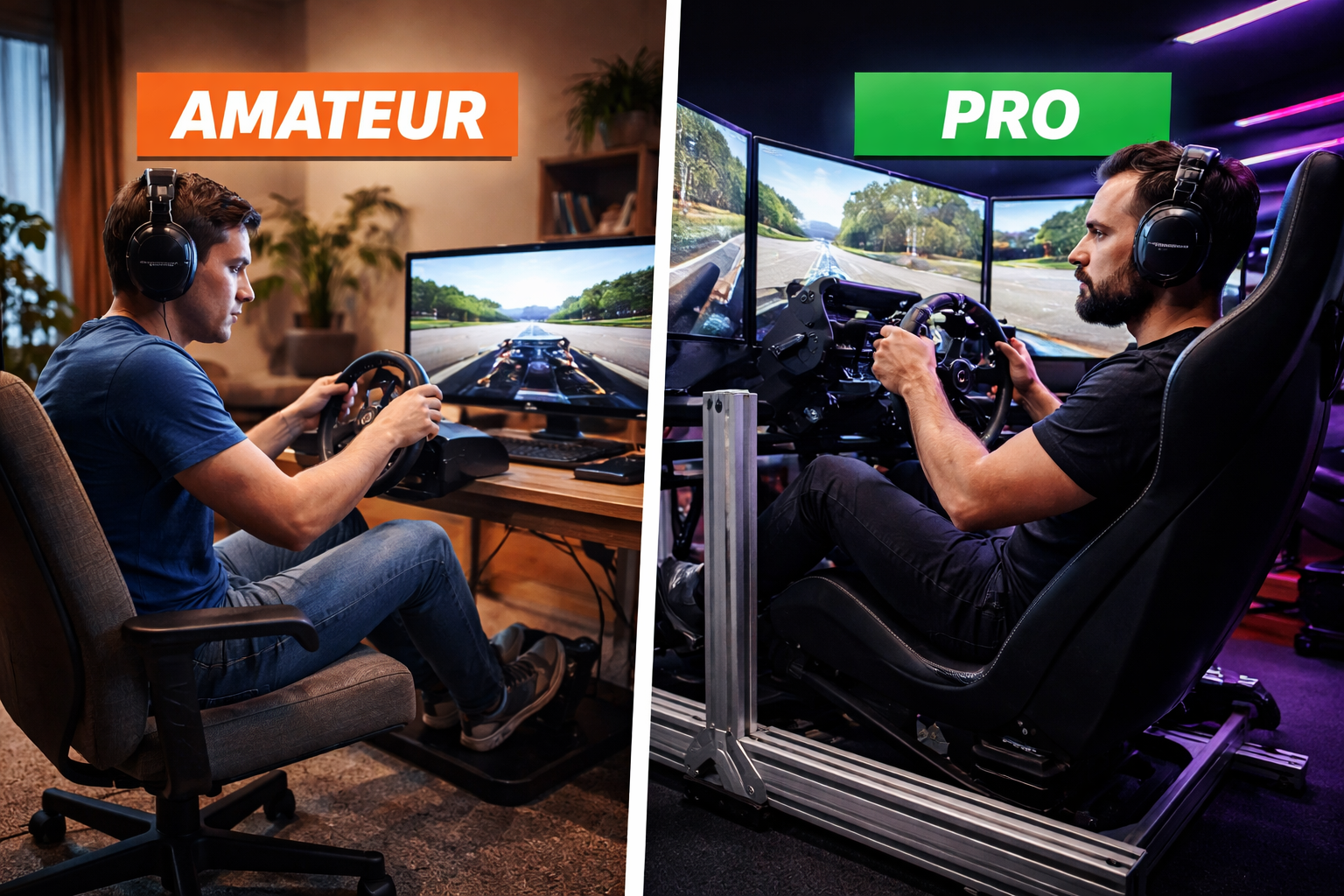
Professionals Start With Driving Outcomes, Not Products
Professional sim racers do not start their buying process by asking “what’s the strongest wheel?” or “what does everyone else use?”. They start with outcomes.
-
Can I brake at the same pressure, lap after lap, in traffic and under fatigue
-
Can I feel loss of grip early enough to react, not just after the slide begins
-
Can I run long stints without physical strain or inconsistency
Every hardware decision flows from these questions. If a component does not improve consistency, it is irrelevant — regardless of price or popularity.
Amateurs, by contrast, often buy emotionally. They chase perceived realism, visual appeal, or community hype, assuming better hardware automatically equals better performance.
Why professionals obsess over pedals (and amateurs don’t)
The single biggest difference between professional and amateur setups is pedal prioritization. Elite sim racers almost universally consider pedals more important than wheels.
-
Braking consistency defines lap time repeatability
-
Pressure-based braking mirrors real-world muscle memory
-
Pedals are the primary tool for racecraft, not steering
Professionals invest early in load-cell or pressure-based braking systems and spend significant time tuning pedal feel. Many will happily run a mid-range wheel base if the pedals allow precise, repeatable braking.
Amateurs frequently do the opposite. They upgrade wheels first, chasing torque and force feedback strength, while continuing to use entry-level pedals that rely on travel rather than pressure. This creates inconsistent braking, over-slowing, and poor threshold control — issues no wheel can compensate for.
Torque is a tool, not a target
One of the most visible mistakes amateurs make is equating higher torque with higher performance. Professionals understand torque as headroom, not a performance metric.
-
Higher torque allows detail without clipping
-
Most professionals run well below maximum strength
-
Smooth, information-rich feedback beats brute force
Professional drivers tune their wheels to deliver clarity, not intensity. They want to feel front-end loading, surface changes, and early understeer — not fight the wheel through every corner.
Amateurs often run wheels at maximum strength, masking fine detail and increasing fatigue. This creates the illusion of realism while actually reducing usable feedback.
Rig rigidity beats wheel power every time
Professionals treat cockpit rigidity as non-negotiable. Any flex in the rig introduces inconsistency, especially under heavy braking or fast direction changes.
-
A rigid rig preserves pedal feel
-
Flex changes seating position and muscle memory
-
Consistency requires physical stability
Amateurs frequently underestimate this. It’s common to see powerful direct drive wheels mounted to lightweight frames or desks, negating much of the wheel’s advantage. From a professional perspective, this is wasted money.
A modest wheel on a rigid rig will outperform a premium wheel on a flexible setup every time.
Ergonomics are performance equipment
Professional sim racers pay close attention to seating position, pedal angle, and steering geometry. This is not about comfort alone — it’s about endurance and precision.
-
Poor ergonomics increase fatigue and error rate
-
Consistent posture enables muscle memory
-
Long sessions demand physical efficiency
Amateurs often prioritize aesthetics or compactness, compromising ergonomics to fit a space or replicate a “cool” setup they’ve seen online. Over time, this leads to inconsistent braking, sore joints, and declining performance during longer races.
Professionals choose ecosystems, not just products
Another key difference is how professionals think long-term. They choose ecosystems that allow gradual upgrades and reliable compatibility.
-
Modular components reduce replacement costs
-
Familiar software tuning improves efficiency
-
Consistency across seasons matters more than novelty
Amateurs often jump between brands chasing incremental upgrades, rebuilding muscle memory and re-learning software with each change. Professionals value stability — once something works, it stays until there’s a clear performance reason to change it.
Why professionals buy used (and amateurs fear it)
In professional and semi-professional circles, buying used hardware is normal. Equipment is viewed as a tool, not a status symbol.
-
High-end sim hardware is built for longevity
-
Performance does not degrade quickly when maintained
-
Resale liquidity enables smarter upgrade paths
Amateurs often fear used equipment, assuming “new” equals “better”. Professionals assess condition, compatibility, and performance — not box freshness. This mindset allows access to higher-tier equipment at lower cost.
The biggest amateur mistake: upgrading too early
Professionals upgrade with intent. They wait until they can clearly identify a limitation in their current setup.
-
“My braking consistency is limiting race pace”
-
“I’m losing detail under sustained load”
-
“Rig flex is affecting repeatability”
Amateurs often upgrade reactively, chasing marginal gains without fully exploiting what they already own. This leads to expensive setups that underperform relative to the driver’s skill level.
What this means for buyers in 2026
In 2026, the gap between amateur and professional hardware choices is less about budget and more about philosophy.
-
Professionals buy for consistency
-
Amateurs buy for excitement
-
Professionals optimize systems
-
Amateurs collect components
The fastest drivers are not those with the most expensive gear, but those whose equipment disappears into the background, allowing full focus on driving.
If there is one takeaway from how professional sim racers choose hardware, it is this: performance comes from repeatability, not spectacle.
The smartest upgrade path is not chasing torque, screens, or brand names — it is investing in braking, rigidity, ergonomics, and familiarity. Everything else is secondary.
For anyone serious about improving, thinking like a professional is the most powerful upgrade available — and it costs nothing.
 We have installed cookies on your computer that are strictly necessary to display the site and do not collect personal information. The site also uses cookies to provide a better user experience, which will only be installed if you agree with this.